Joule heating
This source provides users with the ability to add Joule Heating contributions to any thermal solver.
Properties
The option solves an equation for the electrical potential, V, of the form
Where (sigma) is the electrical conductivity. The thermal source is then given by
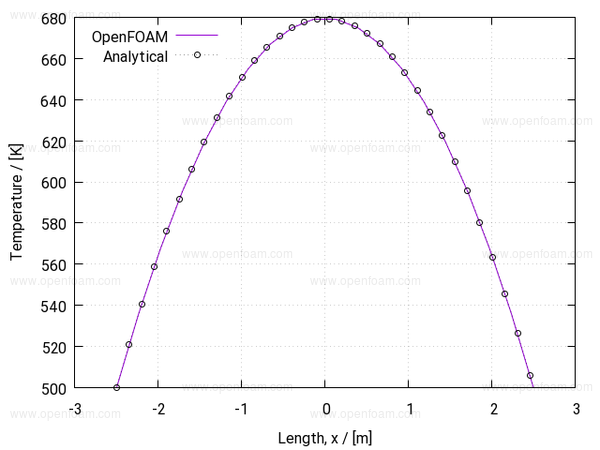
A sample result is shown below
Usage
The option is specified using:
heating
{
    type            jouleHeatingSource;
    active          true;

    jouleHeatingSourceCoeffs
    {
        anisotropicElectricalConductivity no;
    }
}
The electrical conductivity can be specified using either (see usage):
- If not present the
sigmafield will be read from file (standard field sigma) - If the
sigmaentry is present the electrical conductivity is specified as a (potentially uniform) function of temperature using aFunction1type, e.g.
heating
{
    type            jouleHeatingSource;
    active          true;

    jouleHeatingSourceCoeffs
    {
        anisotropicElectricalConductivity no;

        // Optionally specify sigma as a function of temperature
        sigma           table
        (
            (0      127599.8469)
            (1000   127599.8469)
        );
    }
}
- If the
anisotropicElectricalConductivityflag is set to 'true',sigmashould be specified as a vector quantity.
Further information
Tutorials
Source code