Bump (2D)
Overview
- Solver: simpleFoam
- 2D flow over a bump at a Reynolds number of (L=1m)
- Based on the description provided by the NASA Turbulence Modelling Resource
- bump2D
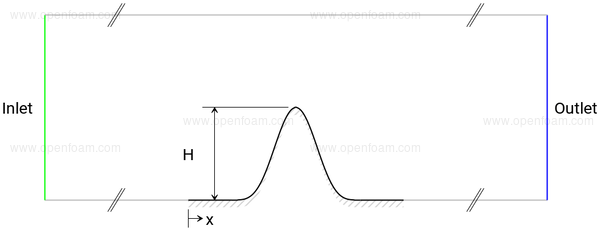
Mesh
-
2D structured mesh created using blockMesh
-
bump described
-
this has been set in the
blockMeshDictusing acodeStream

Boundary conditions
-
based on a Mach number of 0.2. Mach number, , is defined as:
where is the ratio of specific heats, the gas constant and the temperature. Using values for air at 300K, the inflow velocity is given as:
-
The laminar viscosity is derived from the Reynolds number, i.e.
Common fields
Velocity: U
| Patch | Condition | Value |
|---|---|---|
| Inlet | fixedValue | 69.44 m/s in x |
| Outlet | zeroGradient | |
| Bump | noSlip | |
| Walls | symmetryPlane |
Pressure: p
| Patch | Condition | Value |
|---|---|---|
| Inlet | zeroGradient | |
| Outlet | fixedValue | 0 Pa (static) |
| Bump | zeroGradient | |
| Walls | symmetryPlane |
Turbulence fields
- turbulence model: Spalart Allmaras
Turbulence viscosity: nut
| Patch | Condition | Value |
|---|---|---|
| Inlet | calculated | |
| Outlet | calculated | |
| Bump | nutUSpaldingWallFunction | |
| Walls | symmetryPlane |
Spalart-Allmaras
Modified turbulence viscosity: nuTilda
| Patch | Condition | Value |
|---|---|---|
| Inlet | fixedValue | based on |
| Outlet | zeroGradient | |
| Bump | fixedValue | 0 |
| Walls | symmetryPlane |
Results
The NASA Turbulence Modelling Resource employs a code comparison to show that the FUN3D and CFL3D codes produce equivalent results for this case. OpenFOAM and CFL3D results are presented in the following series of images, showing that OpenFOAM results compare very favourably.


