Boundary conditions
In the absence of sources and sinks, system behaviour is driven by its boundary conditions. These form a critical aspect of case specification where ill-posed combinations will lead to physically incorrect predictions, and in many cases, solver failure.
OpenFOAM offers a wide range of conditions, grouped according to:
- Constraints: geometrical constraints, e.g. for 2-D, axisymmetric etc.
- General: available to all patch types and fields
- Inlet: inlet conditions
- Outlet: outlet conditions
- Wall: wall conditions
- Coupled: coupled conditions, e.g. cyclic
Usage
Boundary conditions are assigned in the boundaryField section of the field
files within each time directory for each mesh patch. The format follows:
boundaryField
{
    <patch 1>
    {
        type        <patch type>;
        ...
    }
    <patch 2>
    {
        type        <patch type>;
        ...
    }
    ...
    <patch N>
    {
        type        <patch type>;
        ...
    }
}
Each condition is set in a dictionary given by the name of the underlying mesh
patch, according to the type keyword.
Details
- For 1-sided, e.g. external boundaries, the normal vector points out of the domain
- Non-orthogonality not included
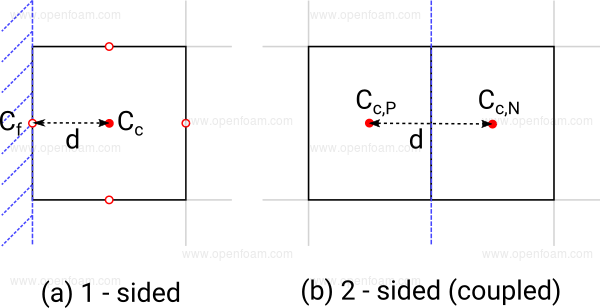
Used when solving the general transport equation to provide:
- value at boundary
- gradient at boundary
Further information
Usage
- Common combinations
- Many conditions employ a
Function1type to describe a property as a function of another, typically time
Source code:
API:
See also: